Passing emergency vehicles
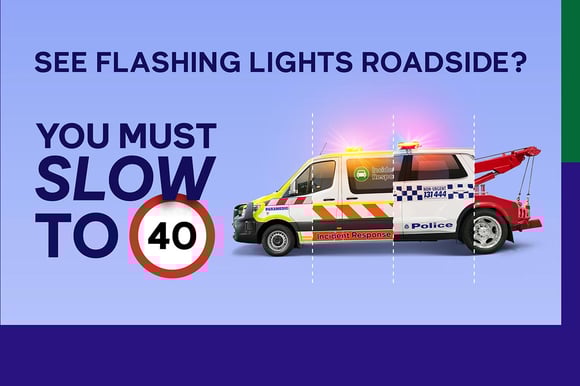
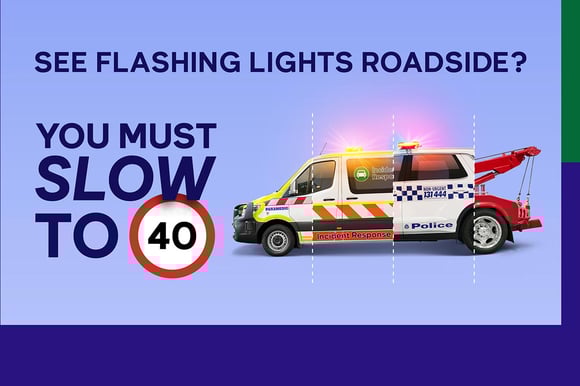
By law, you must reduce your speed to 40 km/h when approaching stationary or slowly moving emergency, incident response, or roadside assistance vehicles with flashing lights or an alarm sounding, whether they are stopped or moving at less than 10 km/h.
When you notice flashing lights (red, blue, magenta, or yellow) and the vehicle is either stopped or traveling at less than 10 km/h, you must:
Begin slowing down to 40 km/h safely (make sure to check your rear-view mirror, especially on high-speed roads).
Pass the scene at 40 km/h, remaining ready to stop if directed to do so.
Resume the legal speed limit once you are at a safe distance from the scene.
This applies to the following vehicles:
Emergency vehicles (including ambulances, fire services, and state emergency services)
Enforcement vehicles (including Victoria Police)
Accident towing vehicles
Breakdown towing vehicles
Roadside assistance vehicles
Incident response services
Escort vehicles
This rule applies in both directions on roads divided by single or double white lines. However, you do not need to slow down if you're traveling on the opposite side of a road separated by a median strip, such as areas with grass, a wire rope, a concrete barrier, or a painted island.
Slowing down on a high-speed road:
Always check your rear-view mirror first, then begin to slow down gradually as soon as you spot flashing lights. Be mindful of current road conditions and avoid making any sudden stops.
In an emergency, law enforcement or incident response vehicles may need to stop in a low-visibility area. If this occurs, reduce your speed, even if the vehicle itself doesn't slow to 40 km/h, will help protect roadside workers and reduce the risk of injury to everyone involved.
Proudly servicing Bendigo and surrounding areas, including Kangaroo Flat, Eaglehawk, Epsom, Huntly, Strathfieldsaye, Maiden Gully, and more.